Keep the fun going after bedtime with these late night sleepover ideas for teens, from quiet games to creative activities and relaxing ways to wind down.
Late at night, even a familiar living room can feel different when friends are gathered together. But once the snacks are gone and the usual games lose their appeal, it helps to have a few fresh ideas ready.
A sleepover is also a chance to try things that might feel too silly, too random, or simply too much effort on an ordinary afternoon.
Some ideas work best with the whole group, while others are more fun with just two or three friends. The list below has a mix, so there’s no need to force everyone into the same activity all night.
Add some friendly competition to the night with these 21 Sleepover Games for Teens That Everyone Will Want to Play.
Quiet Challenges That Keep Everyone Thinking
When the rest of the house is asleep, paper-based challenges offer a way to keep the group occupied without turning the living room into a noisy game zone.
These activities involve code-breaking, detective work, problem-solving, and creative thinking. Most need only stationery or everyday household items, but the fun comes from giving everyone a problem they can genuinely try to solve.
1. Create a Secret Code Only Your Group Understands
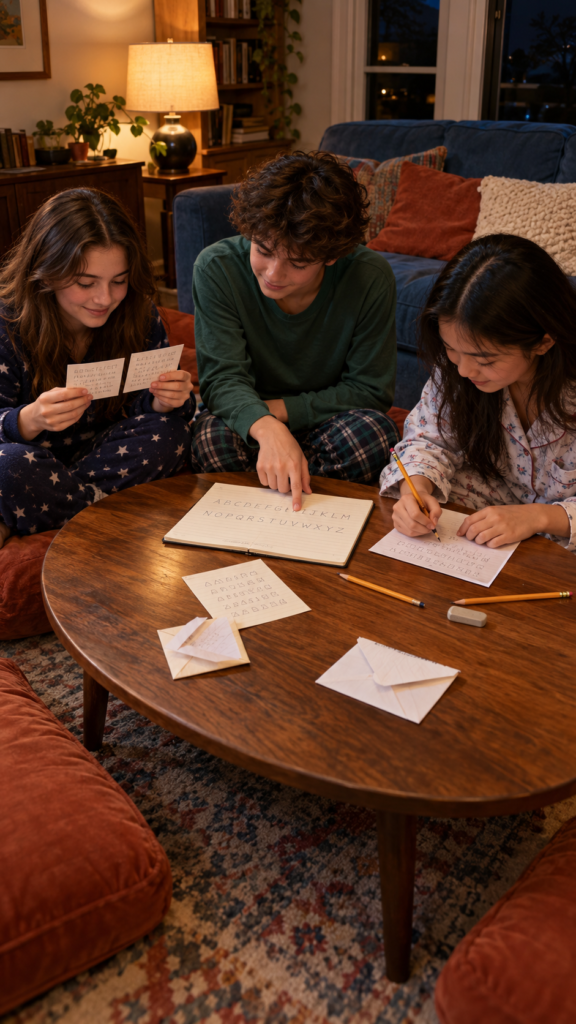
Secret codes hide the meaning of a message behind a set of rules. The sender knows how the code works, while everyone else must discover the pattern before they can read the message.
This makes a good sleepover challenge because players can create their own codes, exchange notes, and test one another without needing phones or special equipment.
Start with a letter-shift cipher. Write the alphabet on paper, then create a second row in which each letter is shifted three places forward. A becomes D, B becomes E, and C becomes F. Using this rule, the word HELLO becomes KHOOR. Give everyone the coded message and see who can work out the rule and decode it.
Once the group understands the basics, make the challenge harder by changing the shift or assigning symbols to letters. For a fair game, each person should keep a key showing how their code works, even if they don’t show it to the other players.
This also helps prevent arguments when a message seems impossible to solve. Remind everyone that these simple ciphers are for fun, not for protecting private information.
For a sleepover suited to 14-year-old girls, see these 29 Sleepover Ideas for 14 Years Old Girls.
2. Solve a Mystery From a Set of Written Clues
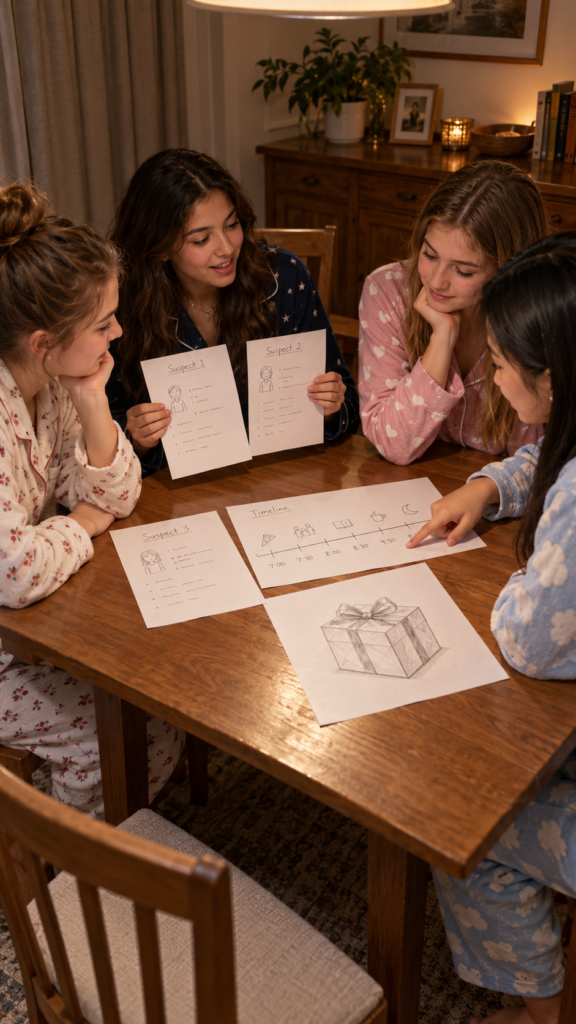
A written mystery is a detective-style game in which players examine evidence to explain an incident. Rather than relying on a lucky guess, they must compare statements, check timelines, and identify which details support or contradict a theory.
Try a fictional case about a birthday gift that disappears from the living room between 9:00 and 9:15 p.m. Prepare three suspect statements and a few pieces of evidence.
One person says they were in the kitchen the whole time, another claims they never entered the living room, and a third remembers seeing the gift beside the sofa at 9:05. Add a further clue, such as a note showing that one person’s stated timeline cannot be correct.
Give the group the evidence together on paper and let them discuss possible explanations. They should identify the clue that matters most and explain how it supports their conclusion.
The person preparing the mystery needs to decide what happened before writing the statements, then check that the clues support that answer.
Otherwise, players may find several equally plausible solutions or discover that the mystery has no answer at all.
For another round, let a different person prepare the case. Keep the incident fictional and light-hearted; the point is to practise reasoning together, not to accuse real friends of taking things.
When everyone needs to stay indoors, these 31 Indoor Sleepover Ideas for Teens offer plenty of ways to spend the evening.
3. Try a One-Page Logic Puzzle Race
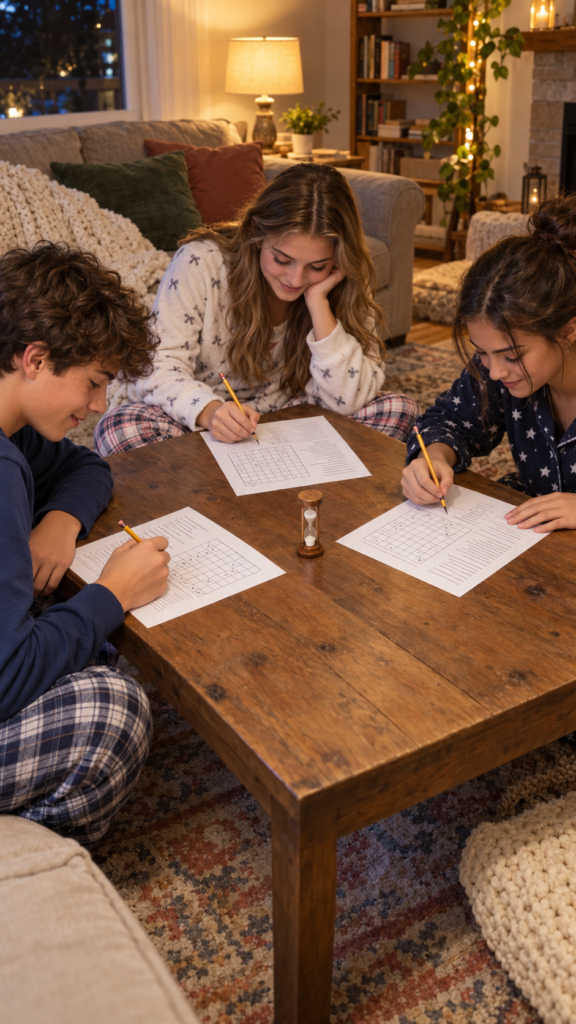
Logic puzzles ask players to use a set of facts to work out an answer, ruling out possibilities that do not fit. In a group race, everyone tackles the same puzzle independently before comparing solutions.
It works particularly well when the puzzle has enough clues to require thought but can still be completed in a short sitting.
For example, imagine that three friends, Mia, Tolu, and Grace, each chose a different late-night snack: popcorn, biscuits, or fruit. The clues say that Mia chose neither popcorn nor fruit, and Tolu did not choose biscuits.
Players must use those clues to match each friend with a snack. In this case, Mia must have biscuits, Tolu must have popcorn, and Grace must have fruit.
For the actual activity, print or write a slightly more involved logic puzzle with several clues and give everyone about 10–20 minutes, depending on its difficulty. A small grid can help players track which combinations are possible and cross out those that aren’t.
If a puzzle requires obscure knowledge or has ambiguous wording, choose another one; the challenge should be in connecting the clues, not guessing what the question means.
After time is up, compare the answers and ask how each person reached their conclusion. Someone who solves it more slowly may have a clearer explanation than the first person to finish, so reward correct reasoning as well as speed.
Help older teens choose activities they will enjoy with these 25 Cute Sleepover Ideas for 15 Year Olds That Are Actually Fun.
4. Build a Paper Bridge That Holds the Most Coins
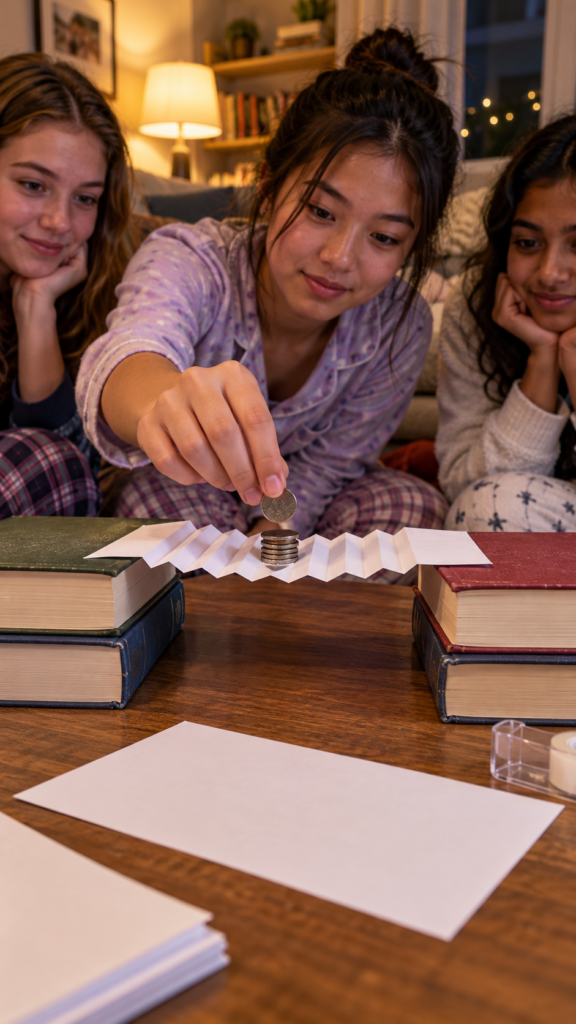
This hands-on engineering challenge explores how the shape of a material affects its strength. A sheet of paper bends easily when laid flat, but folding it into ridges or other shapes can help it support a greater load.
The aim is to build a bridge that spans a gap and holds as many coins as possible before bending or collapsing.
Divide the group into pairs and give every team the same number of sheets of paper and the same amount of tape. Place two stable stacks of books a short distance apart, leaving a gap for the bridge.
Teams may fold or roll their paper, but they must use only the supplies provided. Before building, let each pair predict which design will be strongest and explain why.
When the bridges are ready, place coins in the centre one at a time, using the same coin type and gap for every team. Count the coins each design holds before it fails. Keep the gap low and the test area clear, and avoid using heavy objects that could fall or damage anything.
The useful lesson is that material shape matters. Folds can make paper resist bending better than a flat sheet, although the result also depends on the span, the folds, and how the weight is distributed.
After the first test, let teams adjust their designs and try again. Comparing the first and second results turns the competition into a small experiment rather than just a contest.
Keep the plans affordable with these 23 Cheap Sleepover Ideas for Teens on a Budget.
5. Write a Six-Sentence Horror Story

This short writing challenge asks each person to tell a complete horror story in exactly six sentences. With so little space, writers have to choose details carefully, establish a situation quickly, and leave enough room for an ending that surprises the reader.
Give everyone the same prompt, such as a phone ringing in an empty room or a family photograph containing someone nobody recognises. Ask each writer to include a character, a setting, an unsettling event, and a final detail that changes the meaning of what came before. Allow a few minutes to plan before writing.
One way to create suspense is to begin with something ordinary and make it strange later. A character might hear a familiar knock at the front door, for instance, only to find a note inside the house describing the knock before it happened.
The story doesn’t need graphic violence or a long explanation; a carefully chosen detail can be enough to unsettle the reader.
When everyone is finished, take turns reading the stories aloud. The group can vote for the most unexpected ending, the best use of the prompt, or the story that left the biggest unanswered question.
Keep the voting friendly, and let anyone who doesn’t want to read aloud pass their story to someone else.
Celebrating a birthday with an overnight gathering? These 21 Sleepover Ideas for a Birthday Party can help shape the plans.
6. Design a Mini Escape Puzzle on Paper
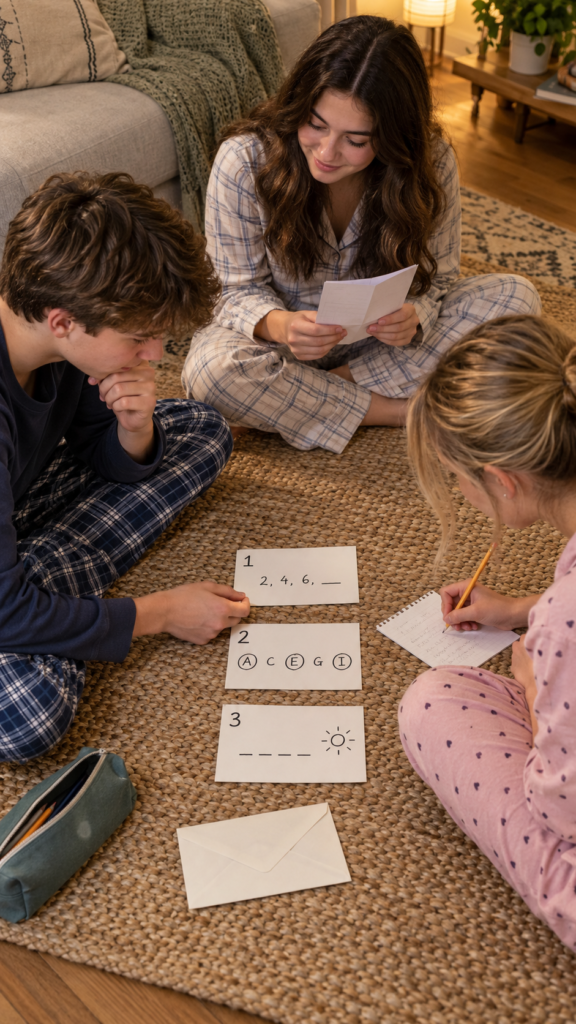
A paper escape puzzle is a chain of connected clues that players solve in sequence to reach a final answer. It borrows the problem-solving idea behind escape rooms but uses written clues instead of physical locks or hidden objects, making it easy to set up quietly at home.
One person prepares three clues. The first could be a number sequence—2, 4, 6, 8, with the answer being 10. That answer tells players to select the tenth letter of a short written message.
The selected letter then becomes part of a final word or helps solve a riddle. For a more substantial puzzle, use a short code for one clue and a word riddle for another, making sure each answer gives players information they need for the next stage.
The creator should write down the intended solution and test every clue before handing the puzzle to the group. Check that the instructions are clear, the answers follow logically, and players aren’t expected to guess information that was never provided.
If everyone gets stuck, the creator can offer a small hint rather than revealing the answer immediately.
Once the group solves the puzzle, swap roles and let another person design a new chain of clues. This gives everyone a chance to experience both sides of the challenge: creating a puzzle that is fair and solving one that someone else has put together.
Give the night a fun theme with these 25 Cute Sleepover Party Themes for Teen Girls.
Creative Projects That Don’t Need a Full Craft Session
Not every creative activity needs paint, glue, or a table covered in supplies. These projects let teens make something personal using paper, pens, cardboard, and a few items they can gather without waking the rest of the house.
They also give everyone something to take home or keep after the sleepover.
7. Make a Personal Mini Zine
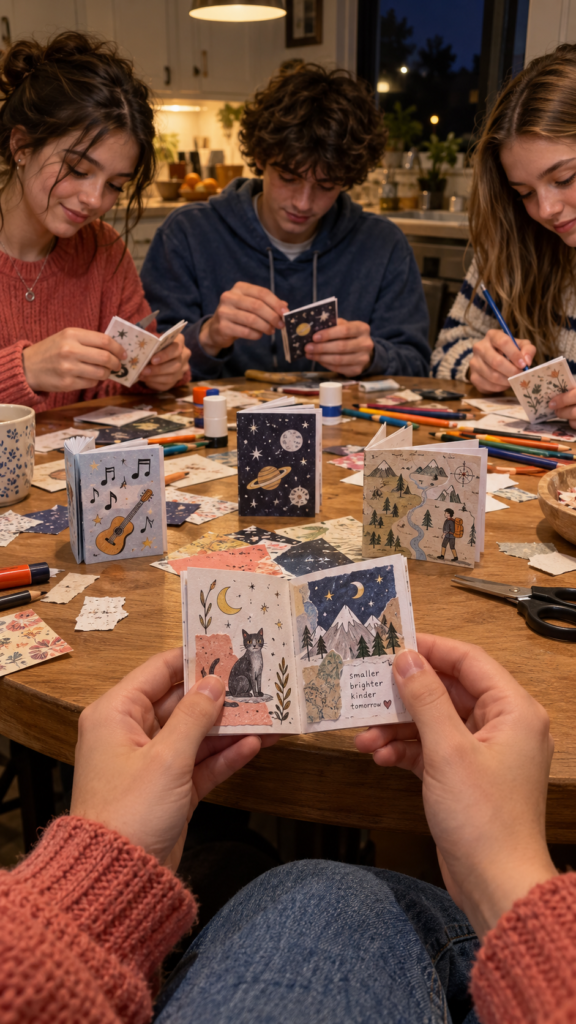
A mini zine is a small, self-made booklet that combines writing, drawings, and pictures around a subject chosen by its creator. It can look like a tiny magazine about favourite films, personal style, music discoveries, fictional characters, or things someone wants to try in the future.
This makes it one of the more personal late night sleepover ideas for teens because each booklet can reflect a different interest.
Start with one sheet of paper and fold it into a small booklet. Everyone chooses a theme and fills the pages with short notes, sketches, headings, or cut-out pictures.
Someone making a music zine might include three songs they recommend and explain what they like about each one, while another person could create a mini guide to their favourite fictional character.
Keep the pages small enough to finish in one sitting. Pens, paper, and a few old magazines are sufficient, although printed images and coloured pencils can add variety.
At the end, let everyone share their zine if they wish. Nobody should have to reveal personal writing they would rather keep private.
For a coordinated look, cosy setup, and cute photo moments, try these 20 Aesthetic Sleepover Ideas for the Ultimate Girl’s Night.
8. Create a Tiny Origami Collection
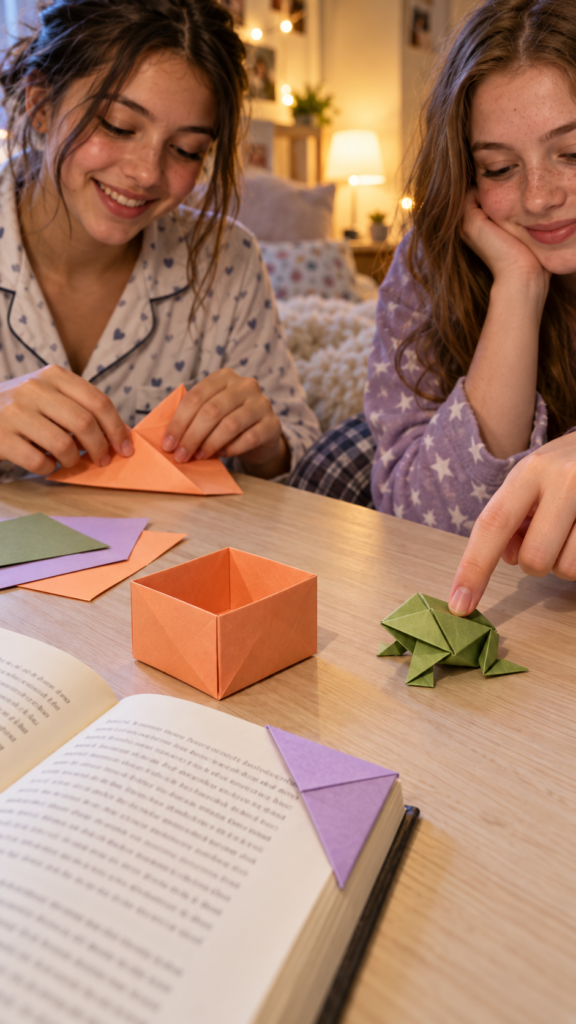
Origami is the art of folding paper into shapes without cutting or gluing it. For a sleepover, the idea is to make a small collection of paper objects with different uses or movements, rather than attempting one complicated model that takes the whole night.
Choose three projects of increasing difficulty, such as a corner bookmark, a jumping frog, and a small paper box.
Begin with the bookmark so everyone can practise making neat folds before moving on to the more involved designs. Square paper usually works best, and thin paper is easier to fold than thick card.
The jumping frog adds a playful element: press its folded back gently and release it to see whether it moves forward. If it barely jumps, compare the folds and adjust the design.
The goal is to understand how the folds affect the result, not simply to see who finishes first. Keep the finished pieces together in a small collection, or let everyone choose one model to teach to another person.
These 27 Sleepover Ideas for 13 Olds offer age-appropriate ways to keep younger teens occupied.
9. Make a Custom Word Search About Your Friend Group
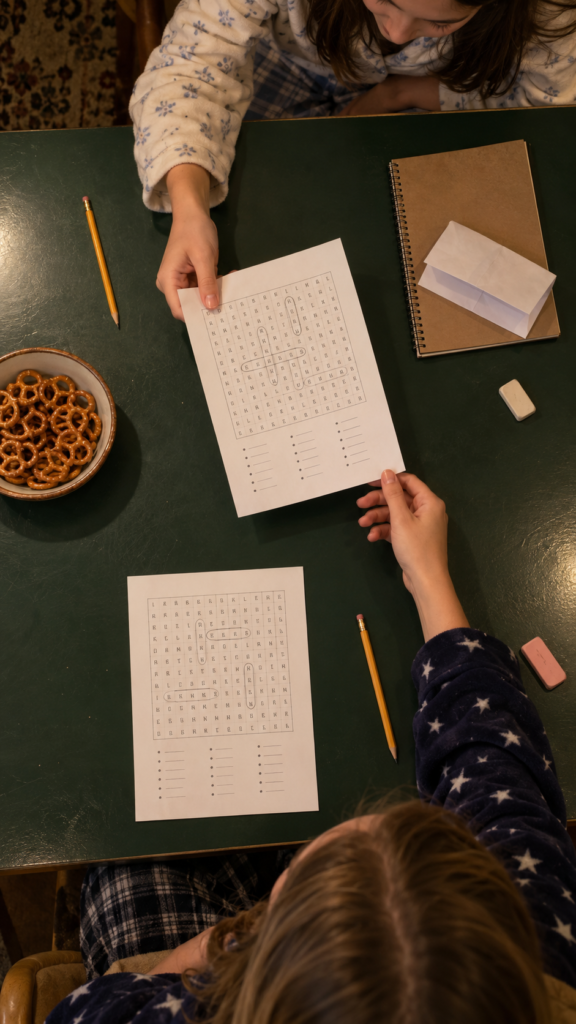
A custom word search is a letter puzzle built around words chosen by the person who creates it.
Instead of using a random list of vocabulary, teens can include favourite films, music artists, fictional characters, hobbies, or harmless expressions the group recognises. The result feels more personal than an ordinary puzzle from a book.
Each person writes down around 10–15 words and places them in a square grid of letters. For a manageable first attempt, use a grid of about 12 by 12 letters.
Hide the words horizontally, vertically, and diagonally, then fill the empty spaces with random letters. Create an answer key showing where every word appears before swapping puzzles with another person.
The interesting part is choosing words that make the puzzle recognisable without making every answer obvious.
Keep the list friendly and avoid private details, sensitive information, or jokes that might embarrass someone if the puzzle is seen by others.
Once everyone has exchanged puzzles, compare completion times or count how many words each person finds within a set period.
A night at home can still feel special with these 23 Fun Sleepover Ideas for Girls at Home.
10. Turn Ordinary Objects Into a Product Design Challenge
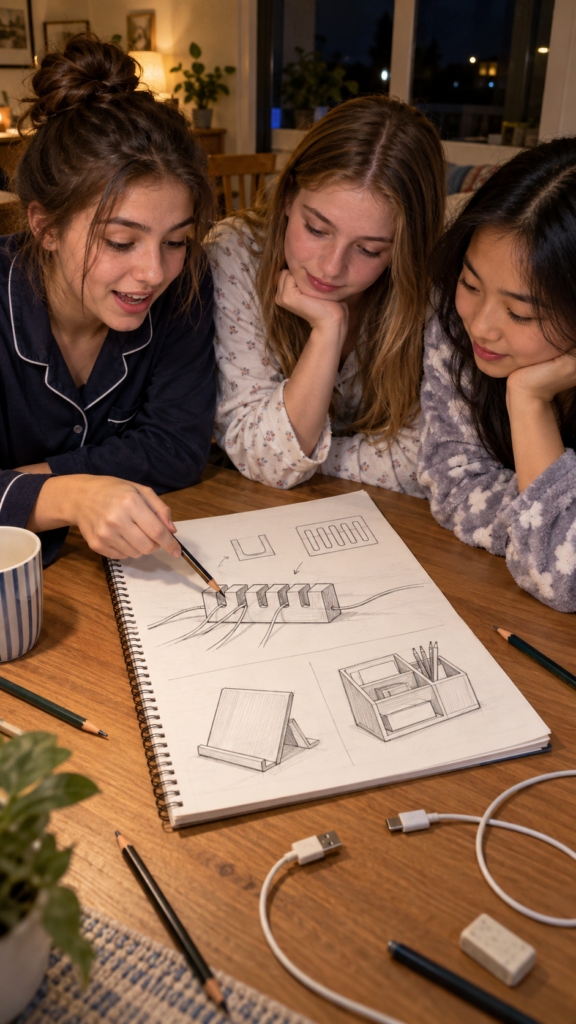
Product design involves identifying a problem and developing an object that could solve it.
In this sleepover activity, teens sketch an idea for something useful instead of simply drawing an imaginary gadget. The challenge is to think about how the product would work for a real person.
Choose an everyday problem, such as charging cables slipping behind a bedside table, books falling over on a shelf, or a phone sliding off a desk.
Give everyone paper and pens, then ask them to sketch a product that could address one of these problems. For example, someone might design a cardboard cable holder with separate slots to keep charging cords in place.
Each person should label the main parts and explain three things: who would use the product, how it solves the problem, and what might make it difficult to use.
A cable holder, for instance, would be less useful if its slots were too narrow for common cables. This extra step encourages practical thinking rather than making the activity a drawing contest alone.
Finish by letting everyone present their idea in a one-minute pitch. Other players can ask sensible questions or suggest improvements, but the aim is to develop the design rather than judge someone’s artistic ability.
Mix games, creative projects, and group challenges with these 30 Fun Sleepover Activities for Teens to Keep Everyone Entertained.
11. Make a Paper Pop-Up Card With a Hidden Message
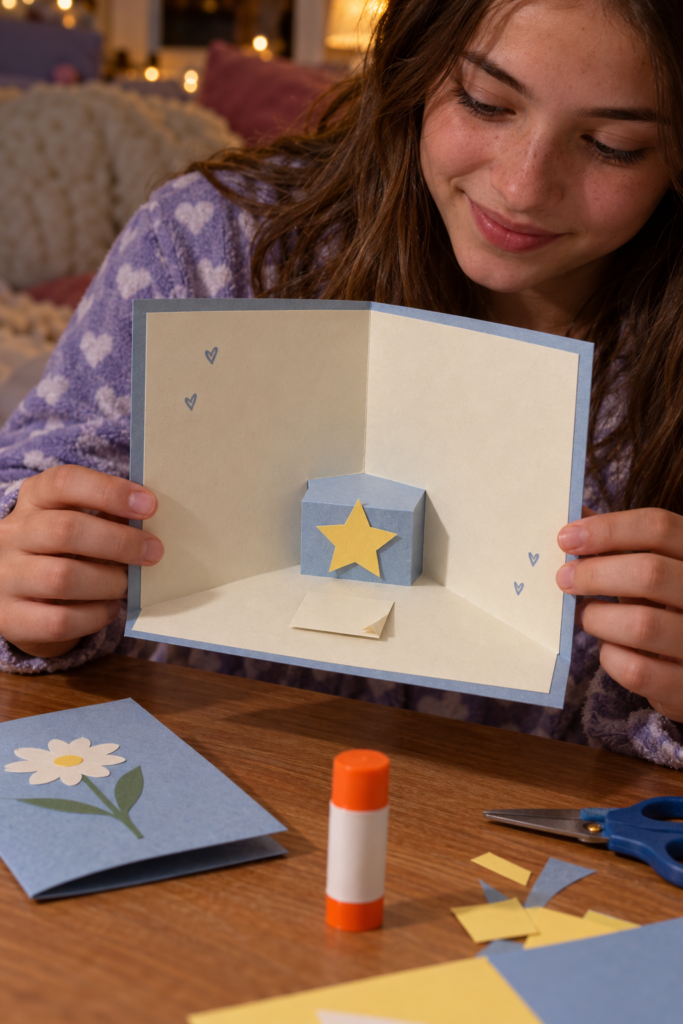
A pop-up card contains a folded paper mechanism that makes a shape or message rise when the card opens. Unlike a flat greeting card, it creates a small surprise inside, making it suitable for a birthday note, an encouraging message, or a funny card for a friend.
Fold a sheet of card in half and make two short, parallel cuts along the folded edge. Push the strip between the cuts inward to create a small step, then open and close the card gently to check that the step moves correctly.
This simple mechanism can support a paper heart, star, or handwritten message attached to the raised section.
Test the mechanism before adding decorations. Thick paper, large cut-outs, or heavy embellishments can prevent the card from closing neatly.
Keep the design simple enough to finish during the sleepover, and write the hidden message inside or beneath the pop-up shape. Everyone can make a different version, then exchange cards or keep them as souvenirs.
For a boys’ night in, these 25 Sleepover Ideas for Teen Boys They’ll Actually Enjoy provide more options than simply watching movies.
12. Design a Phone Stand From Recycled Cardboard
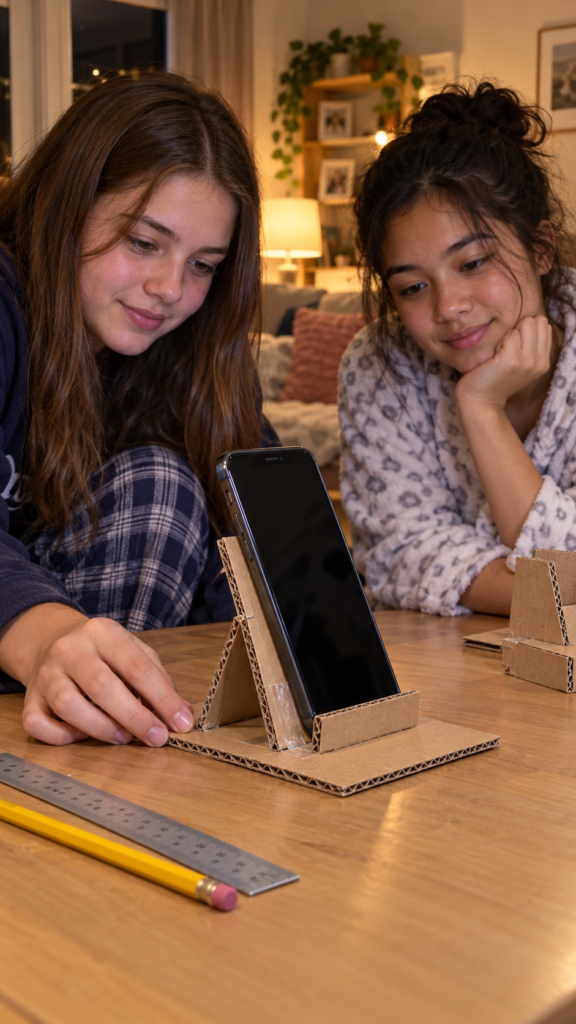
A cardboard phone stand is a small structure designed to hold a phone upright on a flat surface. The challenge combines drawing, measuring, cutting, and testing, with the aim of making something that works rather than merely looks attractive.
Use clean, sturdy cardboard from a packaging box. Sketch a design with a broad base, a support at the back, and a lower lip to stop the phone from sliding forward.
Cut the pieces carefully with adult-approved tools, and ask for help if a cutting tool is difficult to handle. Assemble the stand using slots or a small amount of tape, then test it with a phone of similar size and weight.
Check whether the stand tips over, whether the phone slips, and whether the viewing angle is comfortable. If it fails, adjust the base or move the support further back before trying again.
Keep the design away from heat, avoid covering the phone’s ventilation areas, and don’t charge the phone while testing the cardboard stand. The activity is about learning how a simple structure can be improved through testing.
Find fresh ideas for a girls’ night with these 30 Sleepover Ideas for Teen Girls That Aren’t Boring.
13. Make a Personalised Bookmark for the Next Day
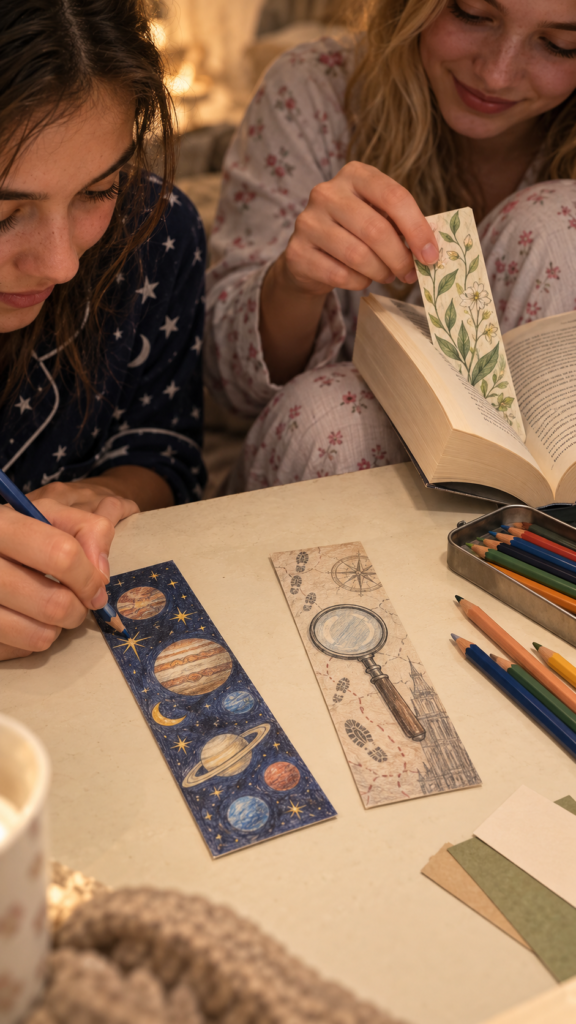
A personalised bookmark marks a place in a book while reflecting the reader’s interests.
Rather than decorating a blank strip with random patterns, each teen can base the design on a book they want to read, a favourite character, a meaningful quote, or a subject they would like to learn more about.
Cut a strip of cardstock approximately 5 cm wide and 15 cm long, then decorate it with pens, small drawings, or a short handwritten note explaining the choice of theme.
Someone interested in mystery novels might draw a tiny magnifying glass, while a person planning to read more about space could add planets and a reminder of a book they want to borrow.
Cardstock holds its shape better than thin paper, and flat decorations are less likely to catch on or damage book pages. Avoid bulky beads or raised embellishments.
For an extra personal touch, everyone can write a book recommendation on the back and exchange bookmarks with a friend. It gives the craft a practical purpose beyond the night itself.
For a mix of activities that can suit different personalities, check out these 31 Fun Sleepover Ideas for Teens They’ll Actually Love.
Social Activities That Give Everyone Something to Contribute
Not every sleepover conversation needs to revolve around gossip or familiar party games. These social activities give teens a reason to exchange opinions, invent stories, defend unusual choices, and learn something about how their friends think.
They also work well late at night because most need only paper, pens, or a few minutes of everyone’s attention.
14. Run a Friendly Debate on Low-Stakes Questions
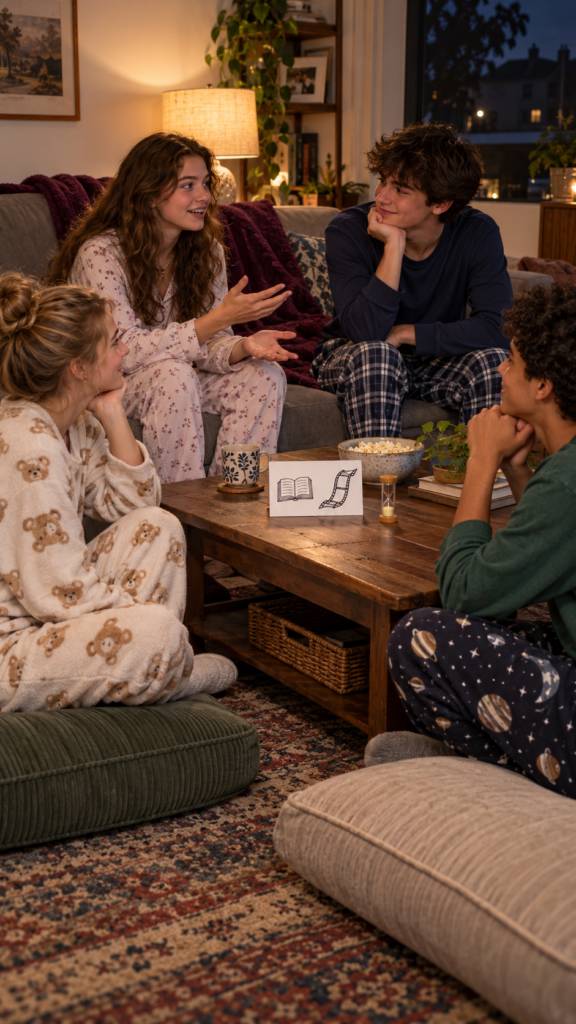
A friendly debate gives everyone a chance to defend an opinion on a subject that doesn’t have serious personal consequences.
The questions can be deliberately silly or connected to everyday preferences, making it easier to disagree without turning the discussion into an argument.
Try questions such as whether a sequel can be better than the original film, whether breakfast food belongs at dinner, or whether books are better than their screen adaptations.
Divide the group into two sides and give each side a minute to prepare its strongest reasons. After both sides speak, let them respond to each other’s points.
For an interesting twist, ask everyone to switch sides halfway through and argue the opposite position. Someone who insists that the original film is always better must now make the case for the sequel.
This encourages participants to consider another viewpoint rather than simply repeat what they already believe. Keep the questions light, avoid topics that target someone’s personal circumstances, and allow anyone to sit out a round.
Make the birthday celebration last beyond the cake with these 27 Sleepover Birthday Party Ideas for Teens They’ll Love.
15. Hold a “Convince Us” Pitch Session
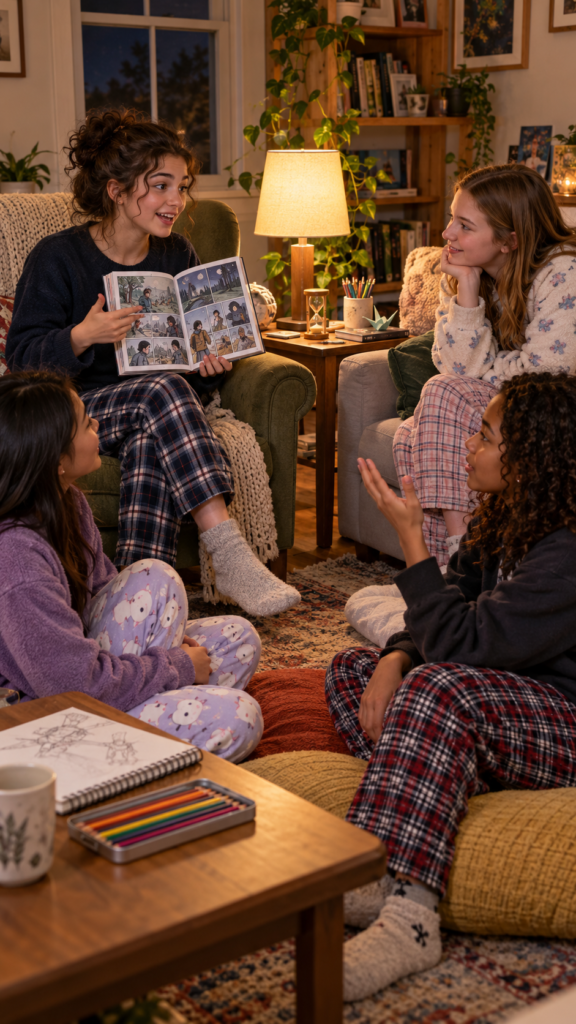
A “Convince Us” session is a short persuasion game in which each person tries to get the group interested in something they enjoy or believe deserves more attention.
The subject might be an underrated book, a hobby, a food combination, a travel destination, or a fictional character.
Give each participant one minute to make their case. Rather than simply saying that something is great, ask them to explain why it deserves a try, give one specific example, and address a possible objection.
Someone recommending a graphic novel, for instance, could explain what makes its characters interesting and why a friend who rarely reads might still enjoy it.
After each pitch, allow one question from the group before moving to the next speaker. The goal isn’t to force everyone to agree; it’s to make a convincing case and perhaps introduce someone to something new.
This also makes the activity useful for practising clear communication without turning the sleepover into a formal presentation.
For celebrations that do not have to include an overnight stay, these 33 Cool Birthday Party Ideas for Teens They’ll Actually Like offer alternatives.
16. Play the Three-Object Story Challenge
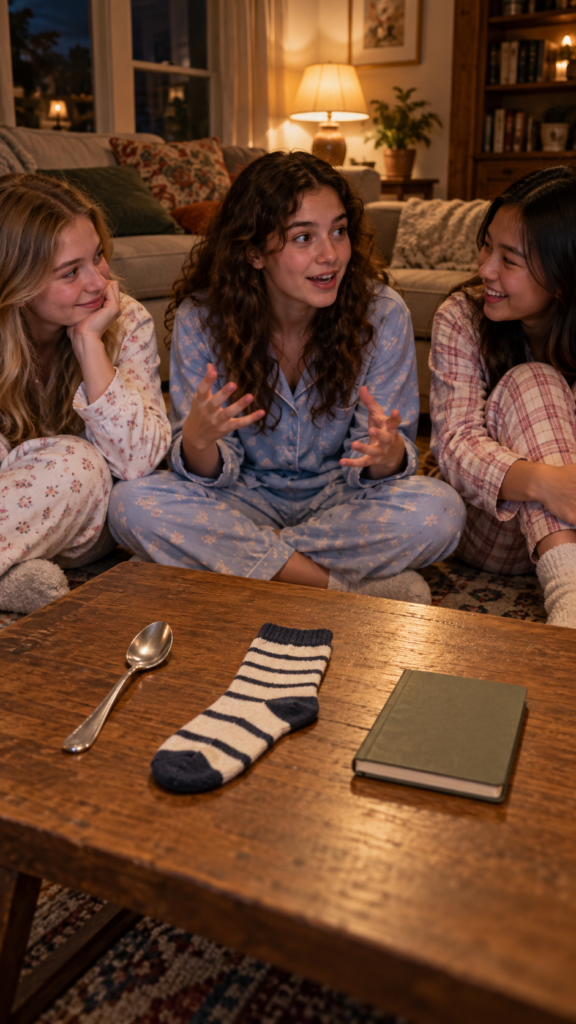
The three-object story challenge is an improvisation game in which every storyteller must connect three unrelated objects in one short narrative. The objects provide the starting point, but the characters, events, and ending are left to the player’s imagination.
Choose three safe household items, such as a spoon, a sock, and a notebook. Give the first person one or two minutes to create a story in which all three play a meaningful role.
The spoon might belong to a detective, the sock could contain a mysterious note, and the notebook might reveal why the objects are connected. The story can be funny, dramatic, mysterious, or completely unrealistic, provided all three objects matter to the plot.
For another round, let the next storyteller choose the objects for someone else. You can also introduce a surprise rule, such as requiring the final sentence to explain an unexpected connection between the three items.
Avoid objects that are sharp, breakable, or difficult to put away. The challenge works best when players can be imaginative without needing elaborate props.
Keep guests involved throughout the celebration with these 27 Birthday Party Activities for Teens That Keep Everyone Entertained.
17. Create a Group Ranking With Evidence
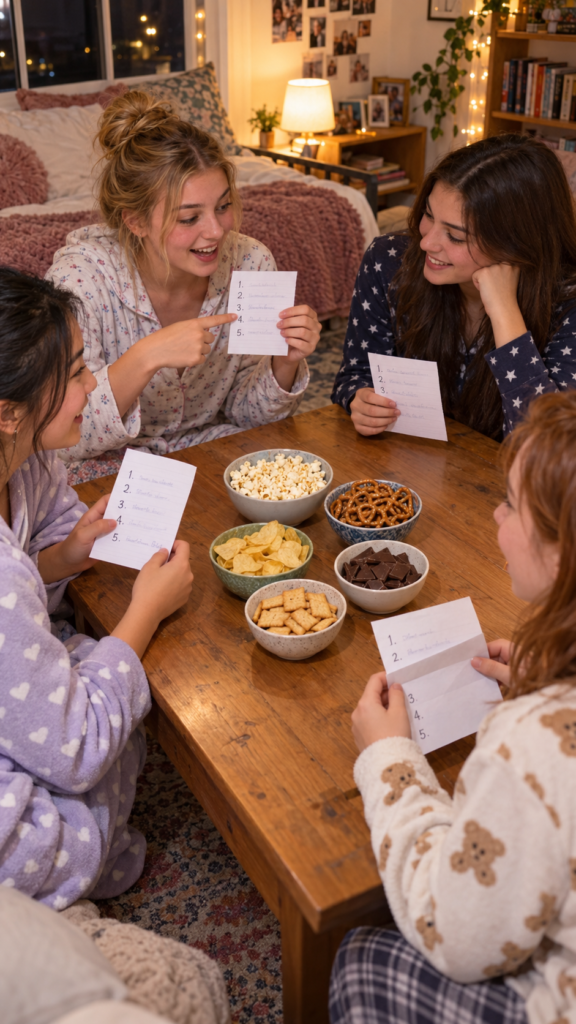
This activity turns a familiar disagreement about favourites into a structured discussion. Everyone ranks five items within the same category, then explains the reasoning behind their choices.
The categories can include fictional sidekicks, animated films worth rewatching, useful inventions, fictional villains, or the best snacks for a movie night.
Ask each person to write their top five privately before revealing the lists. This prevents the first person to speak from influencing everyone’s choices.
Next, each participant explains one ranking that others might find surprising. Someone who puts a side character above the main hero, for example, could explain how that character changes the story or solves problems the hero cannot.
The group can then compare rankings and discuss where their opinions differ.
To keep the conversation meaningful, ask everyone to identify their criteria: are they ranking humour, usefulness, character development, or personal enjoyment? Two people can disagree because they value different things, even when they are discussing the same film.
There is no need to force a single group winner unless everyone wants to vote for one.
Planning a celebration for a 13-year-old? These 29 Creative Birthday Ideas for a 13 Year Old can help you find a suitable plan.
18. Make a Personal “Things I Want to Try” Map
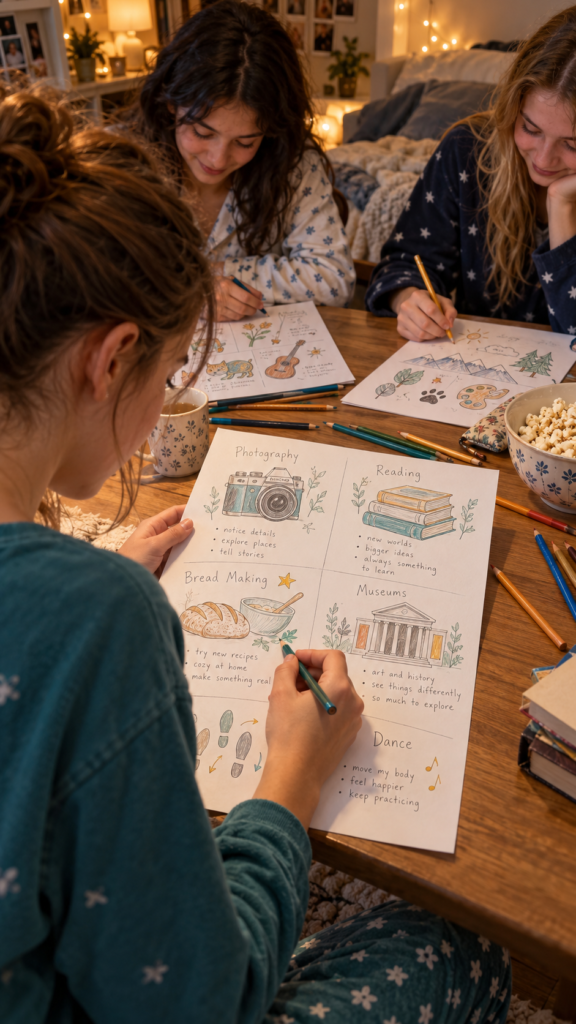
A personal interest map is a visual list of experiences, skills, and activities someone hopes to explore over the coming year. Instead of writing a long list of resolutions, each person groups ideas by subject, making it easier to see what genuinely interests them.
Fold a sheet of paper into sections labelled skills to learn, books to read, foods or recipes to try, places to visit, and experiences to have. Everyone adds a few ideas under the headings.
One person might want to learn basic photography, try making bread, or read a mystery novel, while someone else might be interested in learning a dance or visiting a local museum.
Encourage participants to include things they can realistically try, alongside one or two bigger ambitions. They can mark an idea they hope to attempt within the next month, but there is no need to turn the map into a strict plan. At the end, everyone can share one item if they wish.
Keep the rest private if they prefer; personal goals shouldn’t become a group obligation or a competition over who has the most impressive plans.
For a milestone celebration, consider these 25 Birthday Party Ideas for 16 Years Olds That Feel Special.
19. Play a Memory-and-Details Challenge
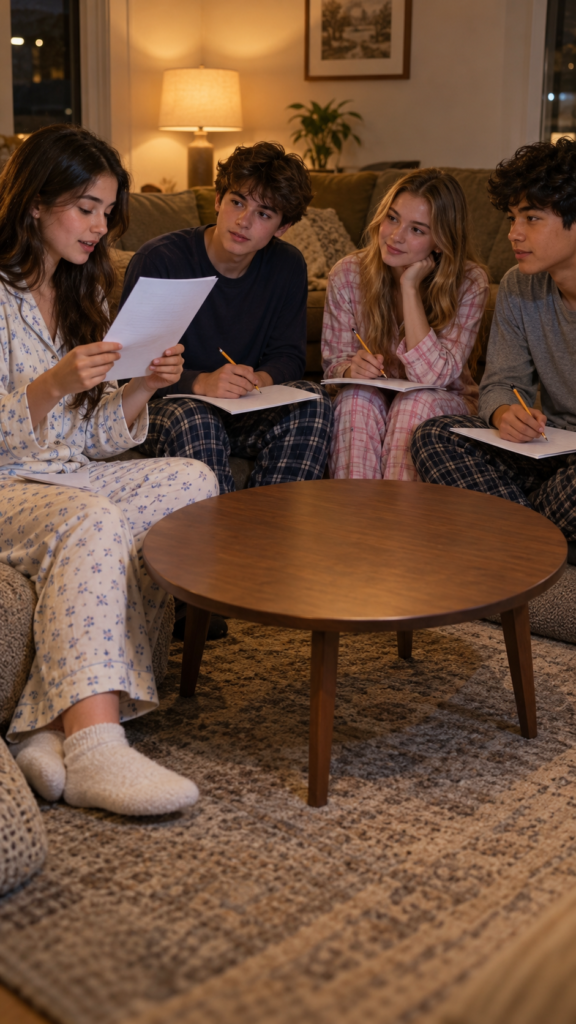
This memory game tests how carefully players listen to a description and how much detail they can recall afterward. It doesn’t require anyone to inspect another person’s room or belongings; the entire challenge can be based on an invented scene read aloud.
One person prepares a short description of a fictional bedroom, desk, or shop containing around 10–15 details.
For example, the desk might have a blue notebook beneath a lamp, two coins beside a cup, a folded map in a drawer, and a small plant near the window. Read the description once at a steady pace without showing the written version.
Everyone then writes down as many details as they remember. Compare the answers with the original description and award a point for each accurate detail.
You can make a second round harder by including similar items, such as two notebooks of different colours, or by asking players to remember where objects were placed rather than merely naming them.
The aim is to notice details, not to embarrass anyone who remembers less. Allow players to compare how they approached the task: some may remember colours, while others recall locations or groups of objects.
Keep the descriptions short enough to hold everyone’s attention, especially late at night.
Add easy treats to the birthday menu with these 23 Easy Birthday Snacks for Teen.
20. Create a Shared “Advice for Future Us” Page
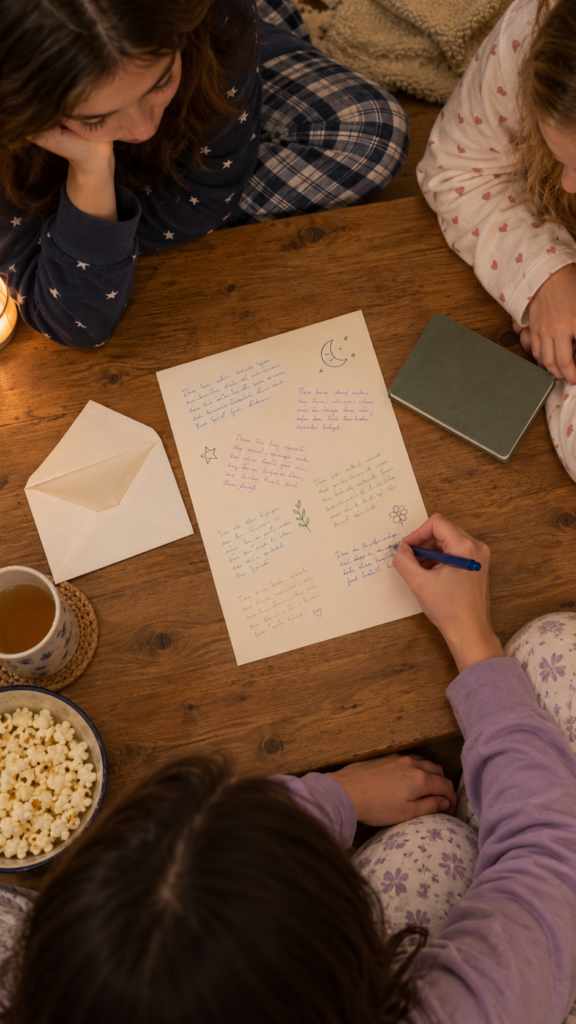
An “Advice for Future Us” page is a group keepsake where friends write short reminders, lessons, or suggestions they may find useful when they read them again later.
It can focus on ordinary experiences rather than deep personal disclosures, so everyone can contribute at a level that feels comfortable.
Place a sheet of paper in the middle of the group and offer prompts such as one thing that makes a difficult school week easier, how to handle a disagreement without making it worse, or a reminder to make time for a favourite hobby.
Each person writes one piece of advice, either under their name or anonymously. For example, someone might write, “Ask for help before a small problem becomes overwhelming,” while another might suggest setting aside time each week for something enjoyable.
Once everyone has contributed, read the entries aloud only if the group agrees. Keep the page in an envelope or notebook and choose a date to revisit it, perhaps at the next sleepover or in a few months.
Nobody should be pressured to reveal private experiences or explain the story behind an entry. The value lies in collecting practical reminders from the group and seeing later which ones still feel relevant.
Bring the party space together with these 25 Cute Birthday Party Decoration Ideas for Teens.
Low-Noise Activities for When the House Is Asleep
Quiet activities can still be interesting when the rest of the household has gone to bed. These late night sleepover ideas for teens focus on observation, drawing, reading and simple challenges that do not require loud music, running around or bright room lights.
21. Try a Silent Lip-Reading Challenge
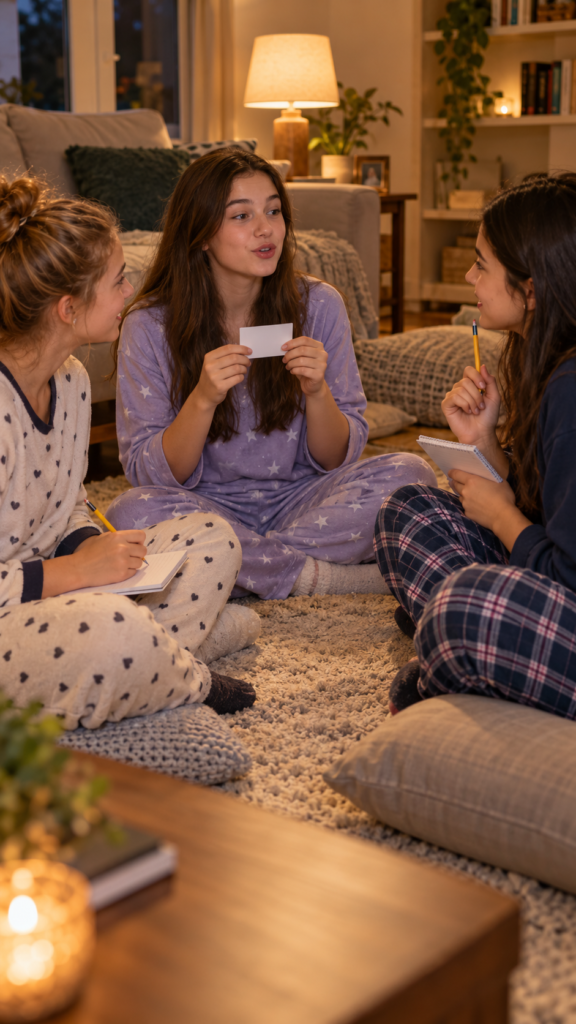
In this game, one person mouths a phrase while the others try to guess the words without hearing them. It can be surprisingly difficult to tell similar words apart, especially when the phrase is longer than a few words.
Write several phrases on slips of paper before starting. Include easy ones such as “pass the popcorn” and harder ones such as “the purple umbrella is missing.” One person picks a slip and mouths the phrase while the others write down their guesses. Reveal the answer before changing turns.
Choose phrases that are funny but not embarrassing, and let anyone pass if they do not want to take a turn. The aim is to enjoy the misunderstandings, not to test anyone’s hearing or speech.
Choose dishes guests can enjoy between activities with these 25 Birthday Party Food Ideas for Teens Everyone Will Want.
22. Identify Household Sounds at Low Volume
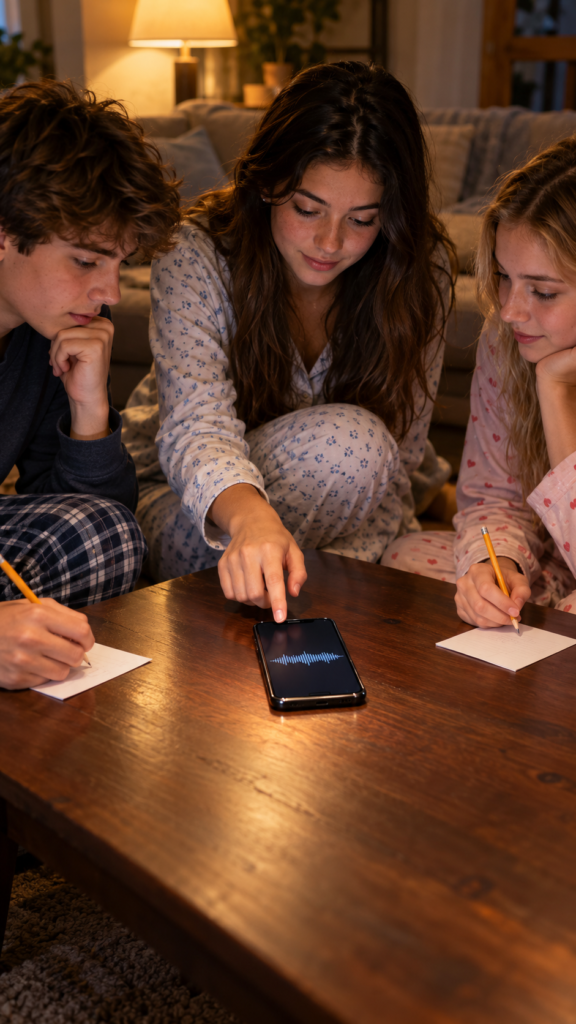
This listening game asks players to identify everyday sounds without seeing what made them. A familiar noise can be harder to recognise when it is heard on its own, which gives the group a small mystery to solve.
Record short clips earlier in the day, such as keys jingling, paper being crumpled, a zip opening or water being poured into a cup. Play each clip quietly from a phone, giving everyone time to write down a guess before revealing the answer. Award a point for each correct answer, or let players explain what clues helped them decide.
Prepare the recordings in advance so nobody has to make noises around the sleeping household. Use ordinary, safe sounds and keep the volume low enough that it does not carry into other rooms.
For a stylish celebration with a coordinated look, take inspiration from these 21 Aesthetic Birthday Party Ideas for Teen Girls.
23. Complete a Small Puzzle Book Together
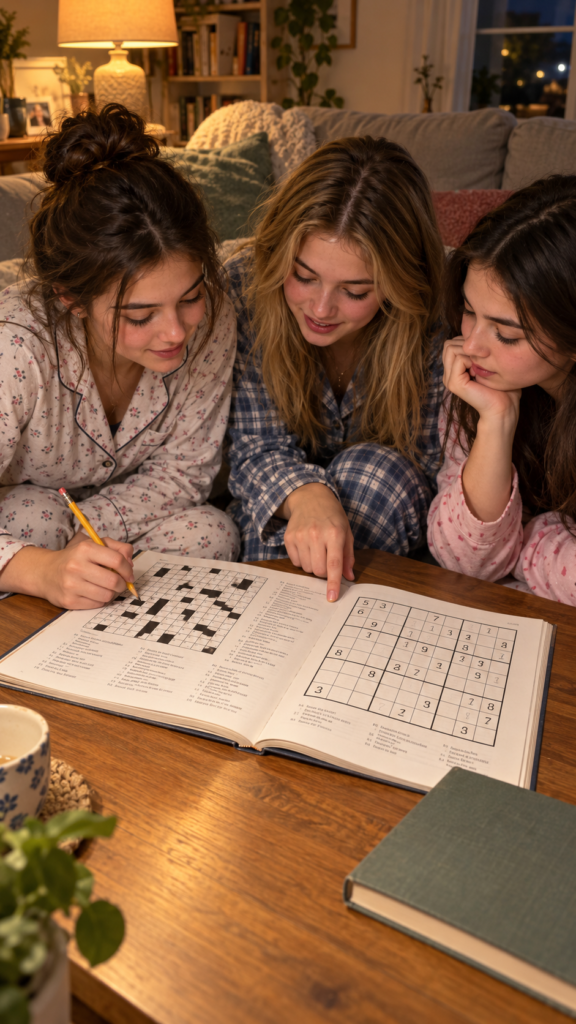
A puzzle book gives everyone something to work on without needing to keep a conversation going. Word searches, crosswords, number puzzles and riddles offer different levels of difficulty, so the group can choose according to its mood.
For a shared challenge, open to a difficult puzzle and let everyone suggest answers. If one person prefers working alone, they can complete a separate page and compare answers later.
With a crossword, for example, one teen might recognise a clue about a film while another knows the meaning of an unfamiliar word.
Keep a pen nearby and use the answer key only after giving the group a fair chance to solve the puzzle. This activity is easy to pause when someone gets sleepy, making it a useful option for the quieter part of the evening.
Teens who enjoy social media trends may like these 20 TikTok Inspired Birthday Party Ideas for Teens.
24. Try a Low-Light Drawing Challenge
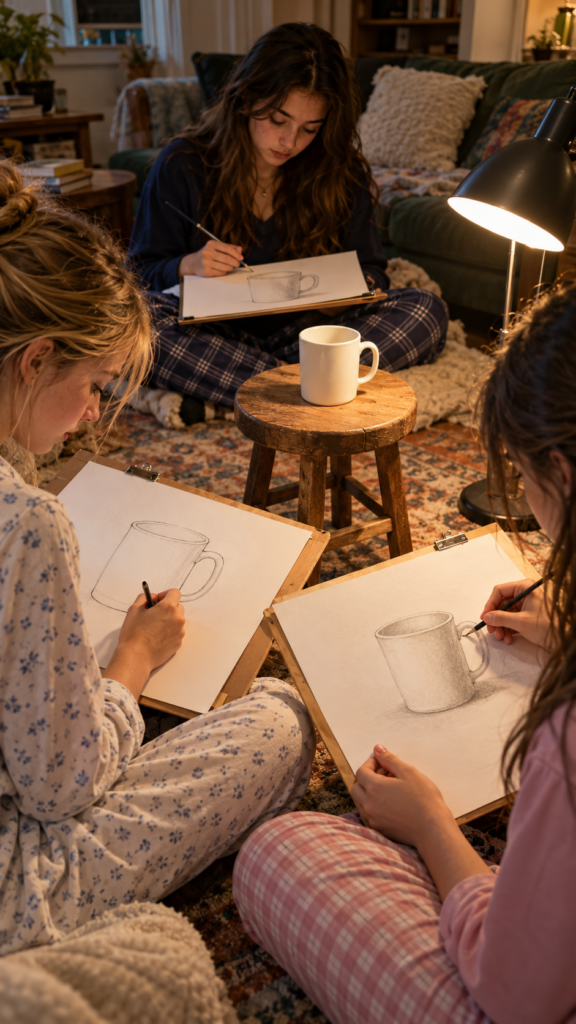
Drawing the same subject under gentle lighting can lead to very different results because each person notices different details. The aim is to interpret the subject in a personal way, rather than produce a perfect picture.
Give everyone paper and pencils, then choose something simple to draw, such as a mug, a pair of slippers or a stuffed toy. Set a short time limit if the group enjoys a challenge, or leave the activity open-ended.
Use a small reading light or another steady light source so everyone can see clearly; avoid drawing in near-darkness or walking around with the lights off.
When the drawings are finished, let each person explain one detail they chose to include. Someone might focus on the shape of an object, while another pays more attention to its shadows or patterns. Keep comments kind, especially when someone is not confident about drawing.
Hosting the celebration at home? These 35 Birthday Party Ideas for Teen Boys at Home offer ideas for making the day fun.
25. Make a Personal Bedside Reading List
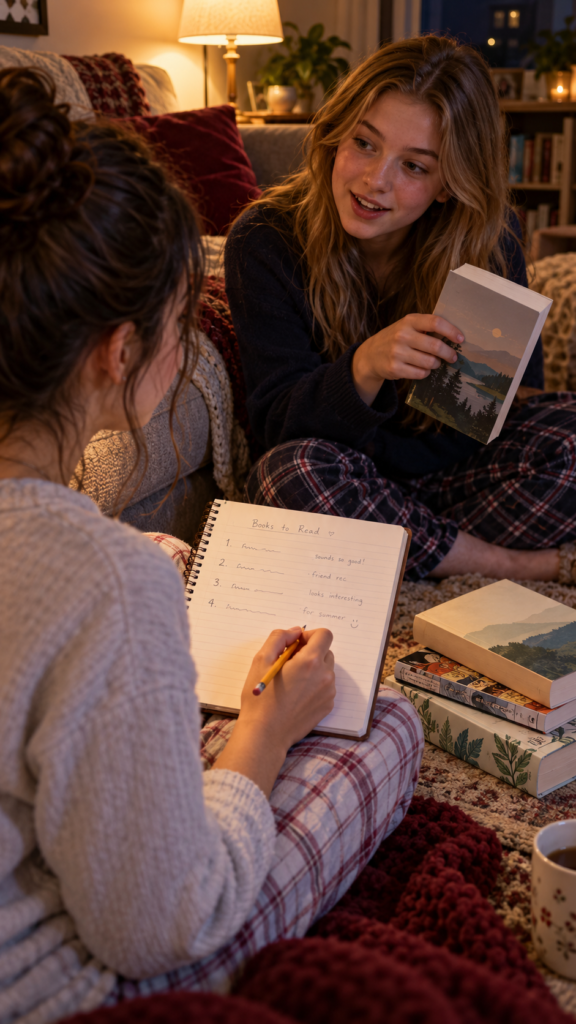
A bedside reading list is a short collection of things someone would like to read when they have a quiet moment. It can include novels, comics, short stories, articles or subjects they want to understand better.
Ask everyone to write down three to five choices. Include one familiar favourite, one title recommended by a friend and one new subject to try.
Beside each choice, add a brief reason, such as “the mystery sounds interesting,” “I want to learn about space” or “my friend said the characters are funny.”
Anyone who wants recommendations can read out their list and receive suggestions from the group. There is no need to start reading everything that night; the finished list can be kept beside the bed and used later.
For a home celebration designed around girls’ interests, see these 33 Birthday Party Ideas for Teen Girls at Home.
Gentle Ways to Wind Down Before Sleep
As the evening gets later, activities can become quieter and more personal. These final late night sleepover ideas for teens help everyone settle at their own pace, without turning staying awake as long as possible into the purpose of the sleepover.
26. Write a Letter to Your Future Self

A letter to a future self records what life feels like at a particular moment. It might describe current interests, a goal, a question that has been on someone’s mind or a small event they do not want to forget.
Give everyone paper and an envelope, then suggest a few prompts: What are you enjoying lately? What would you like to learn? What do you hope you will remember about this year? Writers can keep the letter serious, funny or a mixture of both. They can also choose a date to open it, such as their next birthday or the end of the school year.
No one should have to read their letter aloud. Keeping it private allows each person to write honestly, without worrying about how their words will sound to friends.
A smaller guest list can make planning easier. These 30 Small Birthday Party Ideas for Teens Who Don’t Want a Big Party offer intimate celebration options.
27. Make a Personal Comfort List for Difficult Days
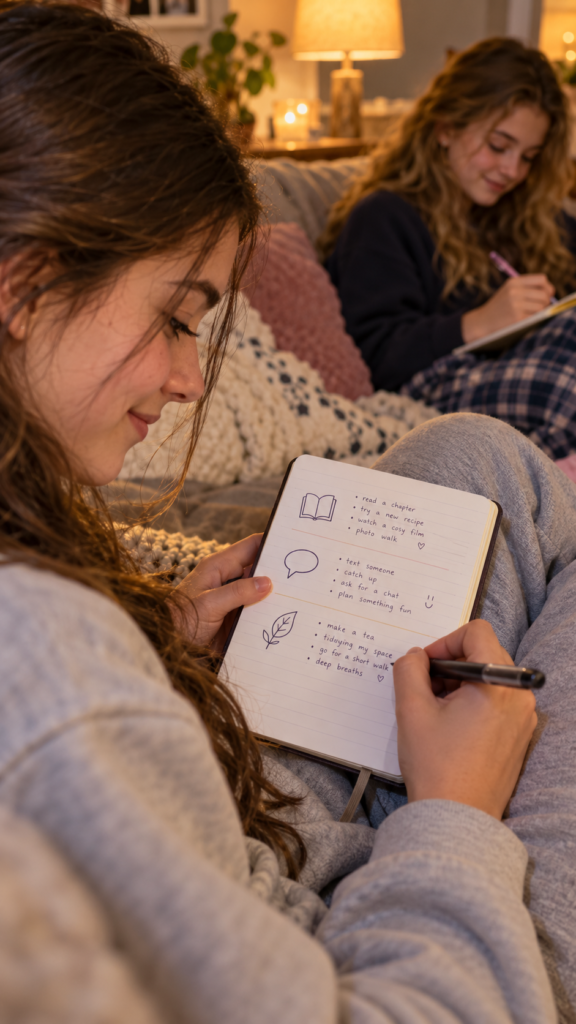
A comfort list is a personal reminder of small things that may help when a day feels frustrating, lonely or overwhelming. It is not a way to fix every problem; it simply makes it easier to remember useful options when someone is having a hard time.
Each teen can divide a page into a few categories, such as things to do alone, people to contact and simple activities that help them feel settled.
Ideas might include taking a shower, reading a familiar book, listening to calm music, getting some fresh air or talking with a trusted adult. The list should reflect what genuinely helps each person rather than copying someone else’s suggestions.
Keep the activity optional and allow everyone to take their list home without sharing it. If someone wants to mention an idea that has helped them, they can do so, but personal experiences should not be demanded as part of the game.
Keep spending under control with these 31 Cheap Birthday Party Ideas for Teens on a Budget.
28. Try a Guided Body Relaxation Exercise
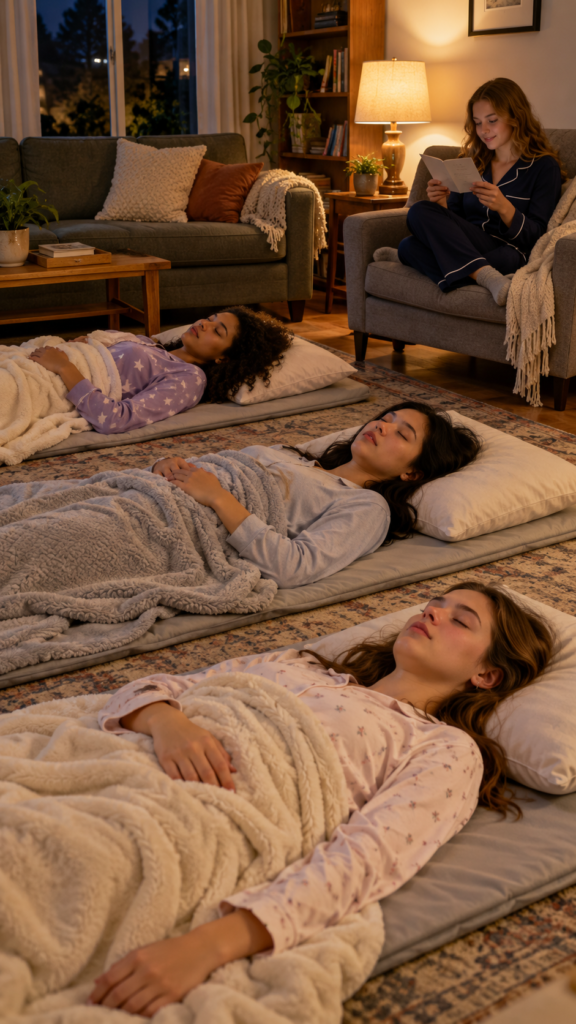
This exercise involves noticing different parts of the body and allowing unnecessary tension to ease. It can be done while sitting comfortably or lying down, with no equipment or special skills required.
Ask everyone to get comfortable and begin by noticing their shoulders.
Move attention gradually to the arms, hands, stomach, legs and feet. At each stage, pause for a few seconds and invite everyone to release any tension they notice, without forcing their muscles to tighten or relax.
A quiet voice can guide the exercise, or someone can use a short, suitable relaxation recording at a low volume.
Keep the instructions simple and give everyone permission to stop whenever they wish. Some people may prefer to lie quietly rather than follow each step, and that is fine too. The purpose is to rest, not to make anyone feel that they are doing relaxation incorrectly.
When the weather allows, take the celebration outside with these 30 Outdoor Birthday Party Ideas for Teens for an Epic Celebration.
29. Set Up a Quiet Sleep Space Together
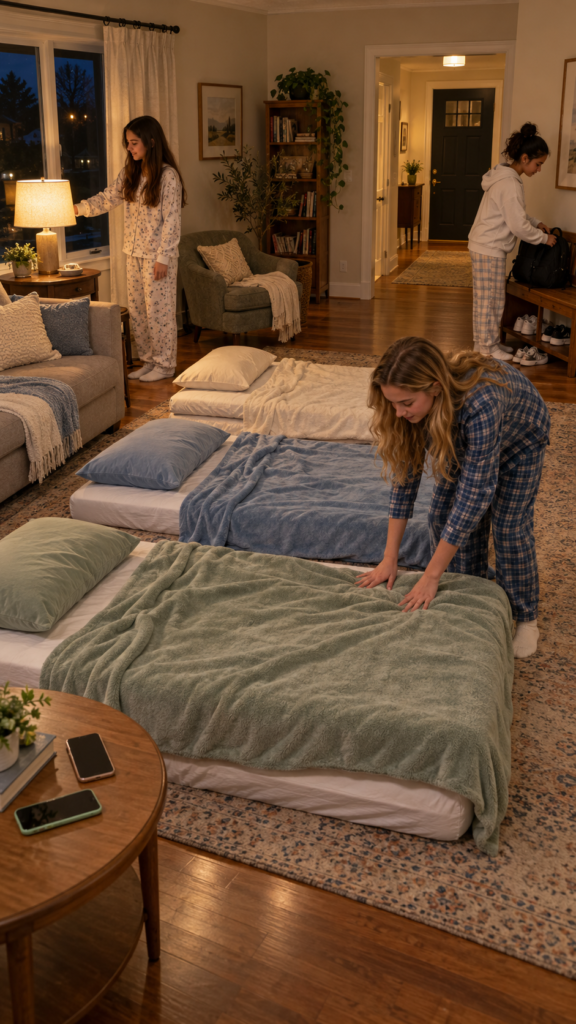
A comfortable sleeping arrangement makes it easier for everyone to settle down without last-minute searching for blankets, moving bags or arguing over space. It also gives the group a clear signal that the active part of the sleepover is ending.
Before settling in, decide where each person will sleep and place bags, shoes and other belongings out of the way. Check that everyone has suitable bedding and enough room to lie comfortably.
Lower device volume, dim the lights and agree on whether phones will be put aside. Phones should still be accessible when needed to contact a parent or guardian.
Teenagers aged 13–18 are generally recommended to get 8–10 hours of sleep per 24 hours.
Staying awake all night is not necessary for a successful sleepover, so allow time for rest rather than treating the latest possible bedtime as a competition. Everyone can finish the evening with a quiet conversation or simply settle down when they are ready.
For a weather-proof celebration, these 29 Amazing Indoor Birthday Party Ideas for Teens offer alternatives for staying inside.
How to Plan a Late-Night Sleepover Everyone Can Enjoy
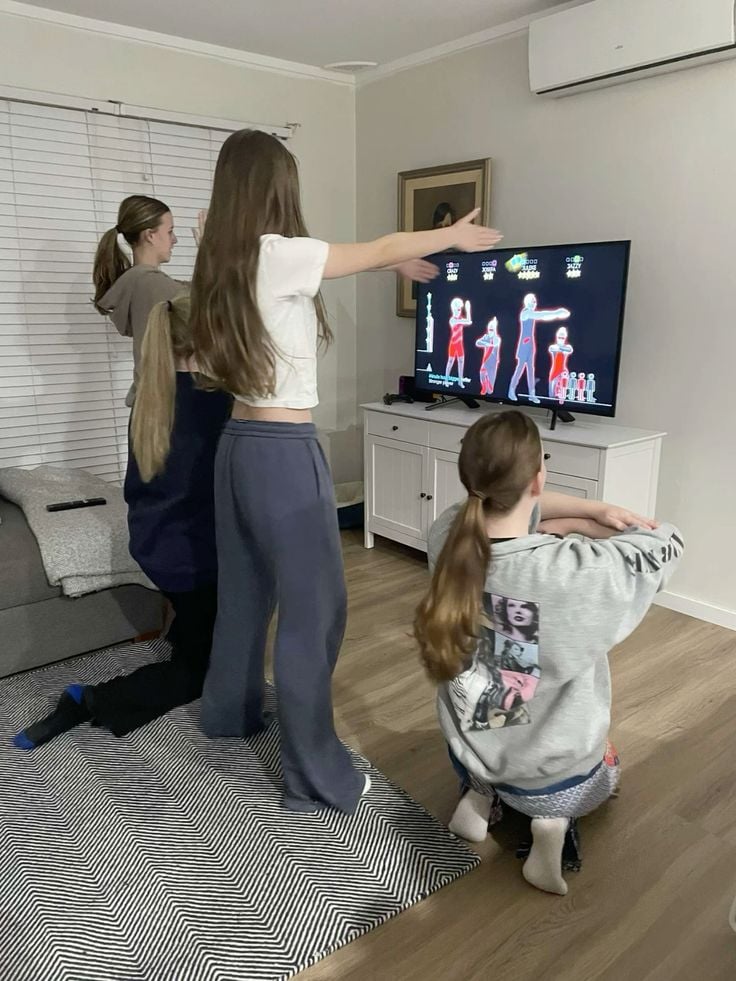
Before choosing from these late night sleepover ideas for teens, consider the house rules, the group’s energy and what everyone feels comfortable doing.
A little preparation makes it easier to enjoy the activities without disturbing others or putting anyone under pressure.
- Check the house rules first. Agree on which rooms are available, when noise needs to stop and whether an adult should help with kitchen equipment, scissors or other tools.
- Match activities to the time of night. Save puzzles, creative challenges and group games for when everyone is alert. Reading, writing and relaxation exercises are better options as people begin to feel sleepy.
- Gather supplies ahead of time. Paper, pens, cardstock, tape, puzzle books and a small reading light can cover several activities. Set everything out before the household settles down for the night.
- Let everyone choose their level of participation. Some teens enjoy competing or speaking in front of a group, while others prefer quiet activities. Offer alternatives, and never make anyone share personal stories or join a game they dislike.
- Respect everyone’s privacy. Ask permission before taking or sharing photos and recordings. Avoid games that pressure friends to reveal secrets, private messages or information about someone else.
- Leave room for sleep. The goal is to enjoy time together, not to see who can stay awake the longest. Choose a natural stopping point when people become tired, and let everyone get the rest they need.
Combine birthday activities with an overnight gathering using these 27 Sleepover Birthday Party Ideas for Teens They’ll Love.
Conclusion
Late night sleepover ideas for teens can be as simple as a quiet drawing challenge, a funny lip-reading game or a letter to open months later. The right activity depends on the group’s mood, the space available and how late it is.
Choose a few favourites from this list of late-night sleepover activities, keep the supplies within reach and let the evening unfold without forcing everyone to join every game. Save this list so you have fresh ideas ready for the next teen sleepover.
Get guests laughing and participating with these 25 Birthday Party Games for Teens That Aren’t Cringey.
FAQs
-
What can teens do at a sleepover when everyone else in the house is asleep?
Choose quiet activities such as writing stories, solving riddles, drawing, reading comics or playing word games. Prepare supplies beforehand and avoid loud music, running or activities that require frequent movement around the house.
-
How do you keep a teen sleepover fun when everyone is getting bored?
Change the type of activity instead of adding more games that feel similar. Move from a group challenge to a creative task, invite friends to suggest an idea or take a short break for a snack and conversation.
-
What can teens do at a sleepover when they are not allowed to use their phones?
Try paper games, charades with silent gestures, storytelling, origami or a group drawing challenge. Agree on a few options before the sleepover so the group has alternatives when phones are put away.
-
How can you handle a teen sleepover when some friends want to stay up and others want to sleep?
Let sleepy guests settle down without making them feel they are missing out. Those who want to remain awake can switch to quiet activities in an agreed area, provided the household rules allow it and others can sleep undisturbed.
-
What should teens do if they feel uncomfortable or left out during a sleepover?
They can take a break, choose a quieter activity or speak privately with the host or a trusted adult. Hosts should avoid games that single people out, pressure anyone to reveal personal information or make participation feel compulsory.